How to buy from Alibaba?
By Yaurapulse
Alibaba Safety & Buyer ProtectionAlibaba is the go-to platform for international buyers to source Chinese suppliers. But how to buy from Alibaba effectively and safely has always been a challenge. The platform gives you access to thousands of suppliers, but it does not guarantee that any of them will deliver what you expect. Buying from Alibaba is a process, not a click-and-ship transaction. Skip a step and you will pay for it later.
Here is the full workflow, from the first search to the day the goods arrive at your door.
Step 1: Know what you want before you search
The biggest mistake new buyers make is searching Alibaba before they know what they want. You type a product name, see thousands of listings, and get lost in prices that range from $1 to $100 for what looks like the same item.
Before you open Alibaba, define your product in writing. What is it? What material? What size? What color? What packaging? What quantity do you need? What is your target landed cost, meaning the product cost plus shipping, duties, and taxes?
A clear product specification does two things. It helps you compare quotes from different suppliers on the same basis. And it gives suppliers something concrete to quote against. If you ask "how much is a water bottle," you will get 50 different answers for 50 different bottles. If you ask "how much for a 500ml 304 stainless steel water bottle with matte black finish and custom logo, MOQ 1000," the quotes become comparable.
For small and medium buyers, the most convenient and efficient way to find suppliers is through online wholesale platforms. Alibaba sourcing is the most popular option. As the largest international B2B trade platform, its search interface is well optimized. You can easily find a wide range of products and contact suppliers directly through the RFQ system.
Step 2: Search and shortlist suppliers
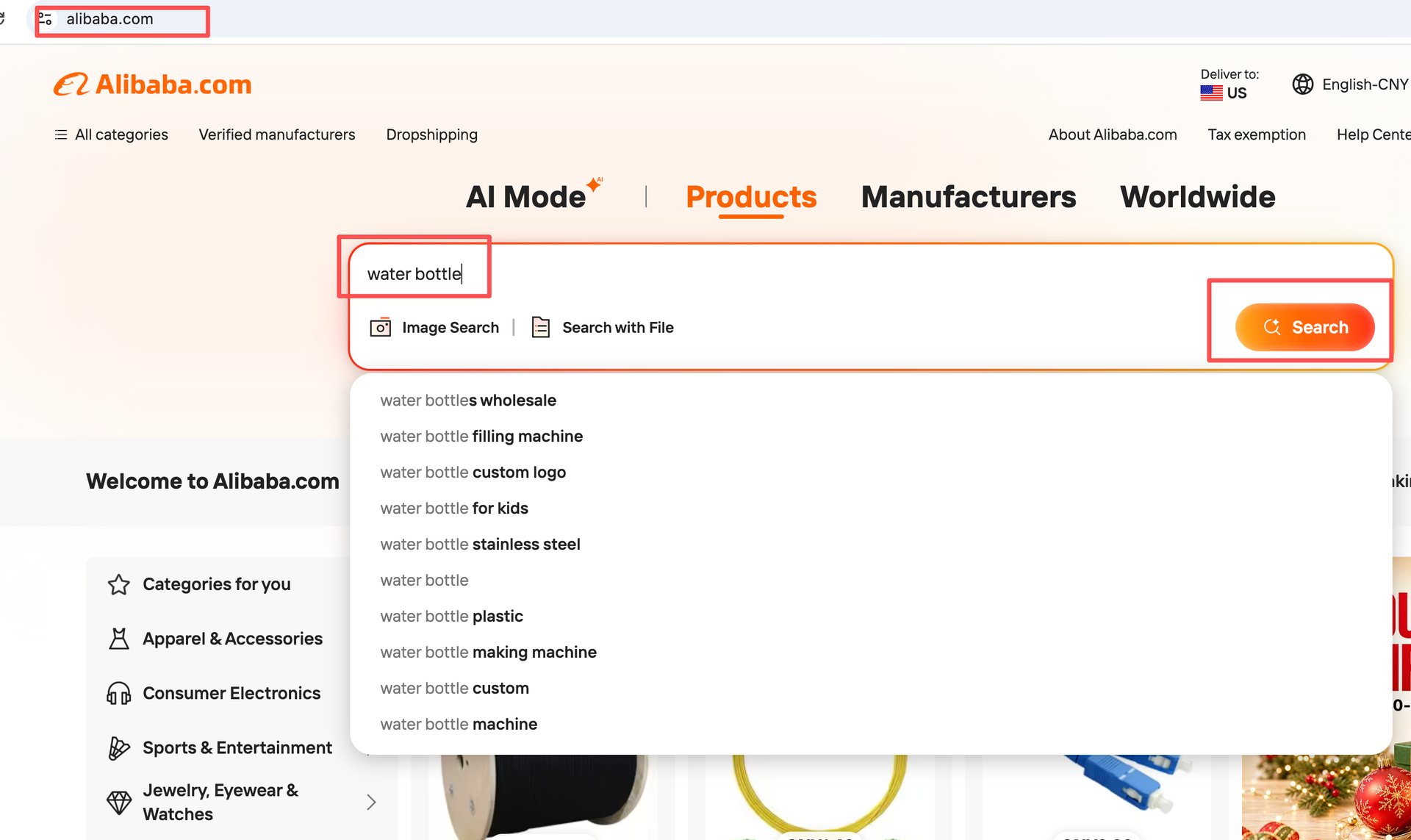
When you search for a product on Alibaba, you will see suppliers concentrated in certain provinces. That is not random. For example, when searching for hose suppliers, you will discover that most are concentrated in Zhejiang, followed by Guangdong. This means hoses are produced in these two industrial clusters. It is easy to find a real manufacturer here.
Look at the supplier's company name. Manufacturers' names typically include words like production, manufacturing, processing, or raw materials. If a supplier's name includes words like E-commerce or trade, they are typically trading companies. Neither is automatically bad, but the distinction matters. Factories usually offer lower prices for large orders but are less flexible on MOQ and communication. Trading companies charge a markup but can handle mixed products, smaller orders, and faster communication.
For another example, among wide-type glass bottles, such as cosmetic glass bottles, candle holders, drinking glasses, and whiskey tumblers, each type involves different production processes, machine types, and production areas. Suppliers with limited knowledge and customization experience cannot accurately understand your actual demand, and their quotes may be too high or too low.
A supplier selling dozens of unrelated product categories is almost certainly a trading company. Real factories typically produce only one or a few similar types of products. If you find suppliers selling LED lighting, party supplies, and garden tools, they are trading companies, not factories.
Whether you are a shopper or a wholesale buyer, the goal is not to find a real factory at all costs. What matters more is whether a supplier can match your budget, quality expectations, MOQ, and delivery timeline. In some cases, a trading company may even be a better fit, especially for smaller orders, mixed products, or faster communication.
Shortlist 5 to 10 suppliers. Do not pick the cheapest one first. Compare response rate, years on the platform, transaction history, and reviews. A supplier with a 95% response rate and 8 years of history is a safer bet than a new supplier with the lowest price.
Step 3: Contact suppliers and get quotes
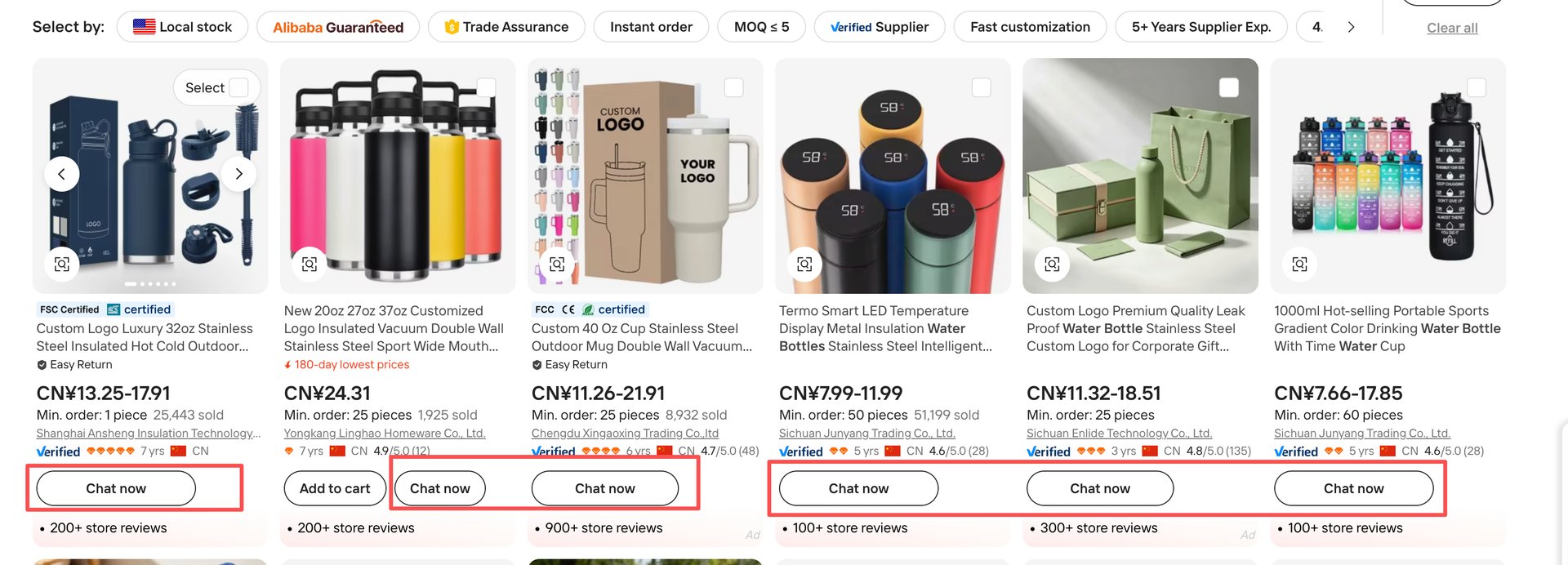
Send an inquiry to each shortlisted supplier. The Alibaba platform makes it easier to communicate and negotiate. This feature removes the need for drawn-out phone conversations or email exchanges. You can quickly engage with possible suppliers and speed up the process.
Your inquiry should include the product specification, quantity, target price if you have one, and any customization requirements. Be specific. Suppliers receive dozens of generic inquiries every day. A detailed inquiry gets a serious response. A one-line inquiry gets a template reply or no reply at all.
Why do suppliers ignore my inquiries? Because your message looks like spam, your quantity is too low, your price is unrealistic, or the supplier is too busy. To get a response, include your company name, the exact product, the quantity, and a realistic timeline.
Compare the quotes. Do not just look at the unit price. Ask what is included. Does the price include packaging? Does it include shipping? Does it include customization? A $2 unit price that excludes everything may end up more expensive than a $3 unit price that includes packaging and logo.
If the actual quote is much higher than the listed page price, that is normal. The listed price is often a starting point or applies to a specific configuration or large quantity. The real price depends on your exact requirements.
Step 4: Order samples
Never place a bulk order without seeing a sample first. The sample is your only chance to verify the product quality before committing real money.
Samples usually cost money, and they should. A supplier who gives free samples to everyone loses money. Expect to pay for the sample and the shipping. In many cases, the sample fee is refundable when you place a bulk order, but confirm this before paying.
Why are sample fees so expensive on Alibaba? Because the supplier has to make a custom product just for you, often using the same production process as a bulk order. The per-unit cost of making one sample is much higher than the per-unit cost of making 10,000 units.
When you receive the sample, test it. Check the material, the dimensions, the weight, the finish, the packaging. Compare it to your specification. If anything is wrong, ask for a revised sample before placing the bulk order.
The reason your Alibaba sample looked perfect while the bulk order failed is usually not mysterious. The sample sold the promise. The bulk order exposed the process. A supplier can make one perfect unit by hand. Repeating that quality across 5,000 units is a different challenge. This is why the sample is necessary but not sufficient.
Step 5: Verify and negotiate
Before placing the order, do a basic background check on the supplier. It is necessary to check the background of suppliers, such as business licenses and product certificates. However, never assume a supplier is 100% reliable based solely on their profiles, which are all self-reported.
Ask for the supplier's business license, verify the company name, and check how long they have been in business. Ask for references or past orders. For large orders, consider a factory audit or a video call to see the facility.
Then negotiate. The price is not the only thing to negotiate. Negotiate the MOQ, the payment terms, the lead time, the sample policy, and the quality standards. As your order value increases, or as you become a repeat buyer, suppliers are more willing to offer better payment terms, such as lower deposits or deferred payment terms.
If you are willing to increase the upfront payment, for example, paying more than the standard 30% deposit, factories are more likely to see your sincerity and feel that you are easy to work with. But do not overpay upfront just to get a discount. The deposit is your leverage.
Step 6: Place the order with Trade Assurance
Large orders are usually handled through Trade Assurance. It is a free service offered by Alibaba to protect buyers by holding payments until you receive the goods and confirm the quality. If there is a problem, you can open a dispute, and Alibaba will step in to mediate.
For Trade Assurance orders, you have to pay on Alibaba. Do not pay outside the platform, even if the supplier offers a discount. A direct transfer arranged over WhatsApp or email removes the order from Trade Assurance entirely. The discount is rarely worth the lost protection.
Put every detail into the order: product specification, quantity, packaging, delivery date, quality standards, and remedies for non-compliance. The order is your contract. If a term is not written down, it does not exist in a dispute.
The standard payment term is 30% deposit to start production and 70% balance before shipping or against the bill of lading. This is the most widely accepted payment term. The deposit commits the supplier to start production. The balance is your leverage to ensure the goods are produced correctly.
Enhance evaluation with samples and trial orders. Compare and communicate with multiple suppliers, then place a small test order with the best option to see whether they can meet your requirements. Honestly, finding a reliable supplier is a process of constant comparison and small test orders. There is no shortcut.
A trial order gives you a full view of the sourcing process from China. You are likely to encounter unexpected issues, such as defects, shipping delays, and more. This is where you can see a supplier's responsibility, whether they resolve issues or just shift the blame.
Step 7: Inspect before shipment
Once the goods are ready, do not release the balance payment until you have inspected them. Check the defect rate of your shipments before leaving China, especially when ordering from a supplier for the first time. For any quality issues found, contact the supplier promptly to arrange for re-production or compensation.
You can inspect the goods yourself if you are in China, or hire a third-party inspection company. A typical third-party inspection costs roughly $200 to $300 for one working day. The inspector checks a statistical sample against your specification and approved sample.
If everything looks reasonable, you can usually go ahead, release the balance, and arrange shipping. If the inspection finds issues, negotiate with the supplier for rework, replacement, or compensation before the goods ship. Once the goods are on the water, your leverage drops dramatically.
The only way to know a supplier's product and service quality is to place a trial order. During the real cooperation process, observe if the supplier actively responds to all your questions and understands your product requirements, especially custom ideas. When problems arise, see if the supplier actively finds solutions or immediately shirks responsibility.
Step 8: Arrange shipping
After the balance is paid and the goods are inspected, arrange shipping. Alibaba also provides a list of freight forwarders. Just input your shipping details, and you will get plenty of options, similar to searching for suppliers. If you are interested in comparing prices, you can request quotes from them.
However, for beginners, it is recommended to use the product supplier's forwarder. Lacking experience, the forwarders you find yourself may not be cheaper or more reliable than your supplier's. After all, if there is a shipping delay, it is much easier to deal with your supplier directly. Especially if the goods are damaged during transit, your supplier can step in and help coordinate a resolution.
For new importers with relatively small shipments, using DDP shipping is often the simplest option. The DDP price includes the product cost, freight, duties, and taxes. The supplier takes care of shipping, customs clearance, and import taxes. You just wait for the goods to arrive.
Alibaba's delivery time depends on the shipping method, destination, type of goods, how smoothly customs clearance goes, and whether it is peak season. Build extra time into your plan. A 30-day quote can easily become 45 days during peak season.
For shipments via sea freight, air freight, or local trucking, contact your freight forwarder or supplier directly for updates. Tracking on Alibaba is not always real-time, so do not rely solely on the platform's tracking page.
Bottom Line
Buying from Alibaba is an eight-step process: define your product, search suppliers, get quotes, order samples, verify and negotiate, place the order with Trade Assurance, inspect before shipment, and arrange shipping.
The common thread is protection at every step. Use specifications to protect your product. Use samples to protect your quality. Use Trade Assurance to protect your payment. Use inspection to protect your shipment. Use a clear contract to protect your dispute position.
Skip any step and the risk compounds. A supplier chosen without verification can disappear. An order placed without a sample can arrive wrong. A payment made outside Alibaba cannot be recovered. Goods shipped without inspection cannot be easily returned.
The platform makes sourcing accessible. It does not make it safe. The safety comes from the process you follow.